
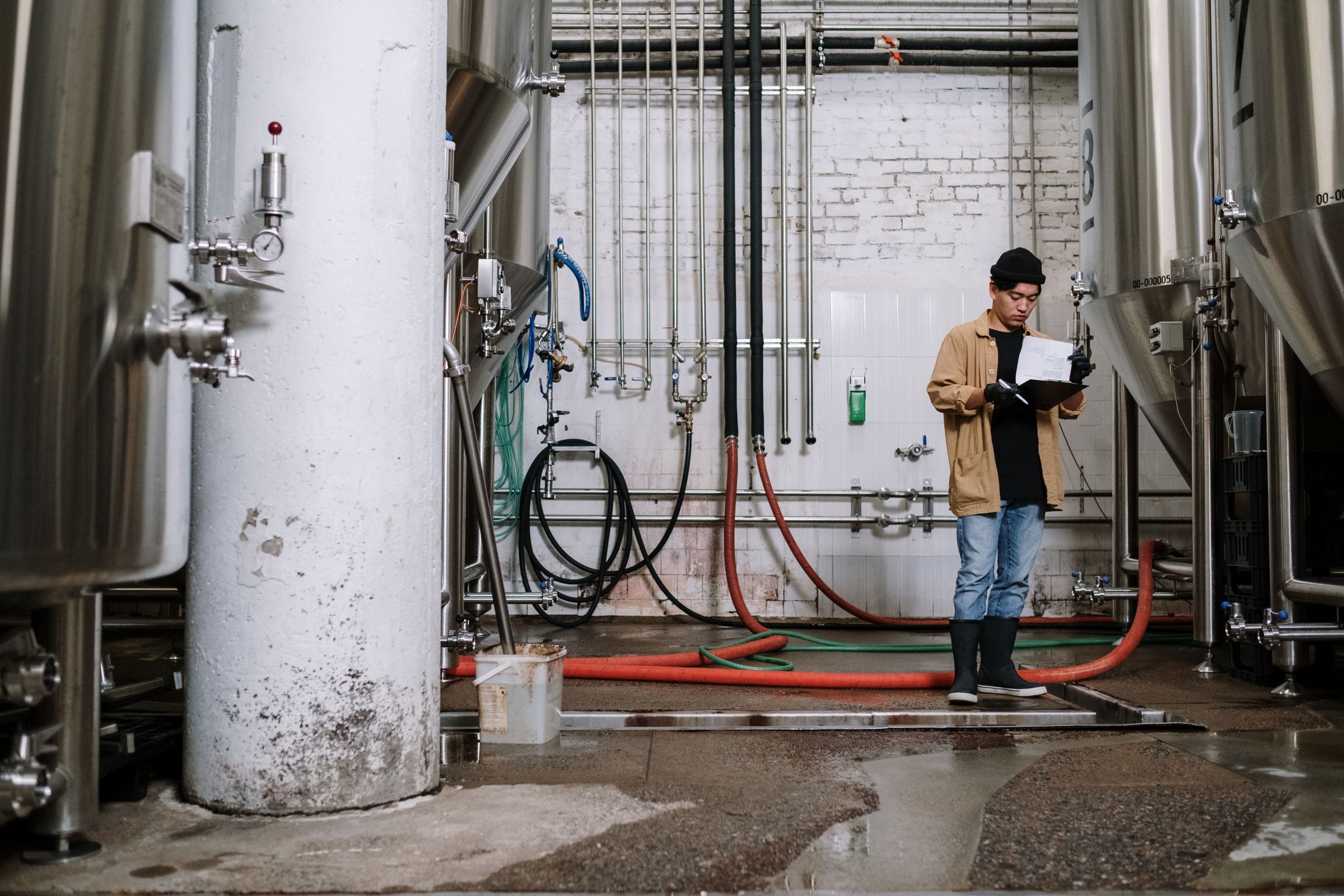
When a brewery experiences recurring microbiological contamination, the first reaction is often to increase cleaning. More caustic is used, CIP cycles are extended, disinfectant concentrations are increased and the same equipment is cleaned again. Sometimes this works, but across brewery investigations we have been involved with in the Netherlands, one lesson has appeared repeatedly: the problem is often not how aggressively the brewery cleans, but whether the cleaning agent can physically reach the place where the microorganisms are living. Logical, right?
A brewery can have an excellent cleaning protocol and still have a contaminated piece of equipment. This happens because cleaning efficacy depends not only on chemical concentration, temperature and time, but also on accessibility, flow, surface condition and equipment design. If a contaminated space is shielded from cleaning solution, a theoretically perfect CIP programme may have very little effect.
This is why recurring contamination should not immediately trigger stronger cleaning. It should trigger an investigation into where microorganisms can survive between cleaning cycles. In many cases, the reservoir is not a large dirty tank but a small, overlooked component that appears completely normal from the outside.
The wort chiller is still one of the first places to investigate
The wort chiller remains a classic contamination risk, and there is a reason it appears so often in troubleshooting discussions. It sits directly at one of the most important microbiological boundaries in the brewery. Hot wort enters the system in a state that is relatively safe, but after cooling the same wort becomes an excellent growth medium and is no longer protected by temperature.
The inside of a plate heat exchanger is also largely invisible during normal operation. This combination makes it particularly dangerous because it can harbour a problem without providing any obvious external signs. A brewery may continue to produce apparently normal batches while contamination slowly persists inside the exchanger.
Cleaning-in-place is necessary, but it should not create false confidence. Deposits, damaged seals, localised fouling or inefficient flow distribution can create protected areas inside the equipment. Even when the cleaning solution reaches the chiller, it may not move through every location with the same velocity or chemical effectiveness.
Our recommendation is therefore simple: periodically disassemble the wort chiller rather than waiting for a recurring contamination problem. Open it, inspect the plates, check the gaskets and look for deposits, damage or areas that clearly have not been cleaned as effectively as expected. A cleaning programme should include physical verification, not merely confidence that a pump has circulated chemicals for the specified number of minutes.
Hoses do not remain hygienic forever
Hoses are another recurring weak point. From the outside, a brewery hose can appear completely functional. It does not leak, the fittings look good and beer moves through it normally, so there is an understandable temptation to treat it as a permanent component.
The inside can tell another story. Repeated exposure to temperature, pressure, cleaning chemicals and mechanical bending gradually ages polymeric materials. The inner surface can roughen, crack or delaminate, and once this happens the hose is no longer simply a smooth tube.
It becomes a habitat. Small pockets can retain product and water, organic material becomes more difficult to remove and microorganisms can attach to the damaged surfaces. Biofilm formation becomes easier precisely because the geometry is no longer smooth and predictable.
At that point, increasingly aggressive cleaning may only delay the problem. The correct action is often replacement rather than another round of sanitation. This is why hoses should have an inspection and replacement programme rather than remaining in service until they finally leak.
The distinction is important because functional does not automatically mean hygienic. A component may still perform its mechanical task while no longer being suitable for clean production. Breweries should therefore inspect equipment not only for failure, but also for changes that make cleaning less reliable.
An O-ring costs almost nothing. The contamination it causes may cost a batch
The same logic applies to seals and O-rings. We regularly see breweries treating seals as permanent components as long as the connection is not leaking. This is understandable from a mechanical perspective, but leakage is not the only failure mechanism that matters in hygienic processing.
An O-ring can become flattened, hardened or cracked long before a connection fails. Microscopic damage can create narrow spaces where beer, wort and microorganisms remain protected from normal cleaning. Once product can enter those spaces, the seal effectively creates a miniature reservoir that may be repeatedly reintroduced into the process.
Material selection also matters. Seals should be appropriate for the chemistry, temperatures and mechanical stresses they experience. They should be routinely removed and inspected, and replacement should be considered preventive maintenance rather than emergency maintenance.
The economics are obvious. Replacing seals costs very little compared with discarding packaged beer, investigating complaints or repeating a contaminated production run. In many cases, the cheapest part of the system can create one of the most expensive microbiological failures.

Filling and packaging equipment deserves much more attention
Packaging is one of the most vulnerable points in the brewery because it is one of the last opportunities for contamination. Filling heads, dispensing nozzles and product-contact interfaces can be especially problematic because they often contain narrow geometries and moving elements. They also repeatedly transition between wet and dry conditions, which can encourage residue accumulation in areas that are difficult to see.
A component can therefore look perfectly clean from the outside while microorganisms remain protected inside. This is particularly relevant for nozzles and small moving mechanisms, where product can dry on internal surfaces and later become rehydrated during production. Even a very small contaminated area can repeatedly inoculate packaged product.
This becomes increasingly important as breweries move toward low- and non-alcohol beers. These products can be more susceptible to microbial growth than conventional beer, and a packaging-line contamination that might previously have caused limited spoilage can become much more serious. The closer the product comes to the consumer, the less opportunity there is to correct the problem.
Packaging equipment should therefore not simply be included in a generic sanitation programme. It should have its own inspection logic, including disassembly of critical parts, visual inspection, targeted microbiological testing and clearly defined replacement intervals for wear components. The final meters of the process often deserve more attention than they receive.

The most dangerous components may be the ones you believe you are already cleaning
This is one of the patterns we find most interesting in practice. Some brewery components can technically be disassembled, but normally are not. Instead, they are removed from the machine and placed in cleaning or sanitising solution, which seems perfectly reasonable because the external surfaces are visibly exposed to disinfectant.
The problem is what happens inside. Consider clamps, couplings, valves or small mechanisms containing moving elements. When a component moves, there must usually be some mechanical tolerance between the moving surfaces, and even a very small tolerance creates a space.
Beer can enter that space. Cleaning solution may not exchange efficiently inside it, organic residue can remain and microorganisms can attach to the protected surfaces. Over time, biofilm can develop in a location that is not visible during routine cleaning.
The component is then submerged in cleaning solution, removed, visually inspected and returned to production. The visible surface is clean, so the cleaning procedure appears to have worked. The protected internal interface may still contain the source of the contamination.
This is exactly why hygienic equipment design is concerned not merely with whether a surface is made from stainless steel, but whether the complete component can actually be cleaned. A technically food-grade component can still be a poor choice if its geometry prevents reliable sanitation.
Our practical rule is straightforward: if a product-contact component moves, opens, rotates, slides, compresses or contains an interface, ask what is happening between those surfaces. If it can be dismantled, it should occasionally be dismantled and inspected. Only then can the brewery confirm whether the cleaning process is reaching the places where contamination can actually survive.
Cleaning protocols are historical documents
There is another common source of risk that receives less attention than equipment. The brewery changes, but the cleaning protocol often does not. A new product is introduced, a different yeast strain enters production, a fruit beer is added, dry hopping becomes more intensive or an alcohol-free product joins the portfolio.
Production volume can also change without anyone reviewing the sanitation programme. Tanks may be used more frequently, filling lines may run for longer shifts and the available cleaning window may become shorter. In all these cases the microbiological risk changes, yet the SOP may remain exactly the same because “this is how we have always cleaned the brewery.”
That is not process control. A sanitation protocol should reflect the process that exists today, not the brewery that existed when the protocol was originally written. Every significant process change should therefore trigger a hygiene review.
The review does not need to become a complicated administrative exercise. It should ask practical questions: has the microbial risk changed, has product composition changed, are there now more residual nutrients, has contact time changed, are new pieces of equipment being used, are new organisms intentionally entering the brewery and has cleaning access changed? These questions are simple, but they force the cleaning programme to evolve together with production.
Equipment quality matters
Craft breweries frequently operate under strong investment constraints, and there is nothing wrong with using simple equipment. However, simple and hygienically designed are not synonyms. A polished stainless-steel surface can still contain poorly designed joints, a sanitary-looking clamp can still create a difficult-to-clean interface and a valve can be mechanically excellent while being microbiologically poor.
A hose can also be technically food grade and still become inappropriate once its surface begins to deteriorate. This is why equipment selection should not stop at certificates or material specifications. The brewery needs to think about how the part will behave after repeated exposure to real production conditions.
The most useful purchasing question is therefore not simply, “Is this food grade?” A much better question is, “How will I know that this is clean after two years of use?” That question immediately brings attention to disassembly, inspection, seals, drainage, dead spaces, surface condition and replacement intervals.
Hygienic design is not luxury engineering. It is preventive microbiology. For small breweries, this is especially important because one poorly designed component can create losses that are disproportionate to the cost of the part itself.
When contamination returns, stop cleaning and start investigating
Repeated contamination is information. If the same microorganism keeps returning after sanitation, it is telling you something about the process. There is probably a reservoir where the organism is surviving between cleaning cycles.
The task is therefore not to clean everything harder. The task is to locate where the organism survives. This requires mapping the process, sampling strategically, opening equipment, inspecting surfaces and comparing microbiological results before and after cleaning.
It is also useful to look upstream and downstream from the first positive point. If the product is negative before one unit operation and repeatedly positive afterwards, the investigation immediately becomes more focused. This kind of process mapping is much more effective than broad cleaning escalation because it turns the problem into a root-cause investigation.
Particular attention should be paid to components that are difficult to see, difficult to disassemble or frequently assumed to be self-cleaning. Those are often the places where the infection hides. Once the reservoir is identified, the solution may be surprisingly simple: replacing a hose, rebuilding a valve, changing a seal or introducing regular disassembly.
The best contamination investigations are therefore not cleaning exercises. They are exercises in understanding the physical system. A brewery does not become microbiologically reliable because everything smells of disinfectant after cleaning; it becomes reliable when the brewer understands where contamination can survive, knows how to inspect those locations and can demonstrate that the cleaning process actually removes it.
For conventional beer this improves quality and reduces losses. For non-alcoholic beverages it may become essential because the safety margin is much smaller. As the product becomes more microbiologically vulnerable, the quality of hygienic design and process understanding becomes increasingly important.

If you need a microbiological consult at your brewery, we encourage you to get in touch with our team via the contact form or by calling us directly.